Sunday, March 22, 2015

'Aho Sipoti mo e Fiefia 2015 (Day of Sports and Happiness 2015)

Me and the Red Squad getting hyped for the days events. 
8:00 a.m. – Arrival
Students walk in scattered, yet strategic alliances toward the school. The youngest—Class 1, 2 and 3-ers—clutch their mothers’ hands under the protective shade of brightly colored umbrellas shielding them from the sun. The Class 4-6’s, having graduated from the need for parental supervision, gather with friends to make their way along the main road traversing the 200 yards of bush-land from their village to the school building.  
Girls with red ribbons braided into their hair walk in groups segregated from green-ribboned girls. Boys in red shorts and shirts roughhouse with each other in manly displays of superiority, serving to both intimidate and challenge their green-clad rivals.  
On any other day, the students might mingle, no barriers hindering their social interactions. 
But, today, lines have been drawn.
Today is Sports Day. The Red Scare vs. The Big Green.
Ain’t nobody messing with their cliques.
8:38 a.m. – Teuteu (Warm-Up/Preparations)
            Chaos ensues as impromptu contests of strength, speed and agility break out between both teams across the pothole-ridden schoolyard, strewn with piles of horse manure at semi-regular intervals.
The teachers look on, making no attempt to restore order despite several altercations that have escalated into tears.

9:04 a.m.
            Teachers begin employing students for event preparations. One boy wields a bush knife, deftly sharpening the stakes that are to be used to line the track. Another compact athlete in a bucket hat holds the stakes steady while Mone—one of the teachers turned officiate for the day—staples sheets of white paper to the sharpened stakes for makeshift flags.

9:33 a.m.
            All preparations complete, students and teachers alike continue to wait. Still not sure why though.
9:58 a.m.
            Teachers assign select Class 6 students the task of corralling all the younger kids into order. They comply by chasing them across the lawn swinging sticks and landing blows on exposed ankles, legs, and backs. The thrill of the chase rapidly vanishes as painful welts rise from the sharp whacks of the sticks.
10:17 a.m.
            As one big group, with clear divisions between red and green, the teachers lead the students to the open field across the main road. Class 6 students run off to deposit the flags in an oval-shaped formation covering the entire span of the field.
10:37 a.m.
            Parents begin to arrive, laden with buckets and bins of every size filled to maximum capacity with food: dozens of packages of cookies, loaves of peanut butter sandwiches, plates of fried chicken and assorted root crops, of mayo and corned beef pasta salads, of curry chicken and handfuls of plain hot dogs, and bowls of la’ipele moa. A recycled jug of vegetable oil accompanies each bin, filled with different varieties of Tang or other sugary drink mixes.
A row of vehicles in various degrees of functionality forms on the newly-trimmed lawn. The men begin setting up rusted poles, covering them with grey tarps to make tents, while the women lay out picnic supplies.
11:12 a.m. – Lotu Kamata/Lea Talitali (Opening Ceremony)
Heu, the Principal at Ha’atu’a G.P.S., stands up to lead everyone in prayer, then to make a speech officially commencing ‘Aho Sipoti mo e Fiefia 2015.
11:20 a.m. – Kamata Ngaahi ‘Iveni (Start of Events)
800 m – Class 6
            Class 6 girls and boys arrange themselves at the starting line alternating red and green. The girls are scheduled to go first, boys to follow immediately after. Mone raises his right arm in the air and calls out to the runners, “on your mark…get set…go!”
            The girls start out at a dead sprint. One of the girls in green separates herself from the pack by about 20 yards before even reaching three quarters of the way through the first lap.
            At what should be the 300 meter mark, but probably isn’t really because the course was just eye-balled, the girl in first place loses steam. She is passed by two girls on red and another on green. At the start of the second lap she slows, setting a pace just barely faster than a walk. The other girls behind and in front of her have slowed to a similar pace.
            The runners slow their pace further, alternating a dozen steps walking with a few desperate strides attempting a run. The four girls in front cross the finish line running at a roughly estimated 2 mph. Those behind drop out and drag their exhausted bodies from the course.
            The Class 6 boys start at a similar breakneck speed, but fare better through the end of the race, with only one or two boys falling off around the 700 meter mark.
Class 1 girls race to the finish line during the 30 meter dash.
30 m – Class 1
            Mone and Mata’anga arrange the first heat of Class 1 girls in their respective lanes at the starting line. After five minutes, the five runners settle into position, waiting for Mone to signal the start.
            Two consecutive false starts ensue.
            The third attempt is flawless, the runners taking off as fast as their legs can propel them forward. 
            The girl in lane two face-plants after she slips in the woodchips used to fill in a small crater in the grassy track. The parents in the audience erupt in laughter.
She scrambles back onto her feet and finishes the race, face strained with the effort of fighting back tears while simultaneously exerting all the strength she has in her.
50 m – Class 2 & 3
            The runners continue to slip and fall on the unpredictable and rugged course.
            The parents continue to screech with laughter and arousing cheers of encouragement.
75 m – Class 4 & 5; 100 m Class 6
            As the runners compete, the spectators from each of the teams on the sidelines engage in a Tongan cheer-off, flavored with spontaneous dance battles. Some of the parents join in zealously.
Green's supporters cheering on their team from the sideline.
Lele Faingata’a (The Obstacle Course) – Class 1-6
            Class 1-4 teachers, Ane, Mata’anga, Meleuini and Mone, converge to set up for the next event. They send several groups of students back to the school building to retrieve the obstacles for the next event: six wooden benches, and three multi-person desks from the classrooms. The older boys come back carrying the obstacles on their shoulders, and set them down in the middle of the track.
            The race begins with the runners sprinting from the starting line to a point about 30 yards away where the teachers placed an empty plastic water bottle and an unripe moli (Tongan orange) in each lane. Each student is supposed to pick up one of the objects, turn, and sprint back to the starting line. They repeat this, picking up the second object on the second down-and-back. On the third take-off from the starting line, they sprint to the next obstacle: two school benches stacked sideways on top of each other to form a small hurdle. The students have to jump over the hurdle, continue running forward, and then dive under one of the three wooden desks set up as the next obstacle. From there they regain their footing, and continue sprinting through the finish line.
The boys from Class 4-6 carrying in the benches and desks to set up the Lele Faingata'a.
On This Week’s Not Top 10
1)   Tevita, a kiniti (kindergarten) student—not even at the primary school yet—jumping in with one heat of the Class 2 races, and running off with the water bottle and moli.
2)   Toafa, a Class 3 boy, soaring over the hurdles then diving under the desk, only to smack his head straight into it in the process. The desk toppled over on top of his head and body. He fought free, leaped to his feet, and continued to the finish line.
1:15 p.m. – Kai Ho’atã (Lunch)
      Parents lay out plates and cups, unloading the buckets of food pre-made at home. The meal is communal style. Women prepare plates for their children and themselves, but also pass around helpings to other groups of women and children around them. Sugary drink mixes are poured into cups, chugged in just a few gulps, and then the cup is refilled and passed along to the next person. One woman, Mele, shoves a plate of fried chicken, boiled eggs and hot dogs onto me, to share with her toddler who has plopped himself down comfortably in my lap. When I’ve finished that plate, another woman invites me to join her circle and urges me to scoop handfuls from her macaroni corned beef salad, with chunks of hopa to wash it down. 
Meleuini, the Class 1 teacher, reps the green team while feasting at the lunch break.
The kids take about a 10-minute break to eat, then clamber to their feet and run back to the track to continue racing against their friends. Over the shared food, the moms talk, gossip and laugh about the various mishaps from the day’s events thus far.
2:00 p.m. – Lele Tangai (Sack Race) – Class 1-6
            At the starting line, the Class 1 girls climb into creased white sacks and position themselves behind the starting line. At Mone’s signal, they leap forward instantaneously. Of the five competitors in the race, only one stays on her feet, just barely, as the others crumble to the ground in various degrees of disarray, tangled up in the sacks. Somehow, they find their feet and continue to hop clumsily, falling again every couple of hops, until the finish line.
            One mom comes to her daughter’s aid in the race, scooping her up from the ground and attempting to hop with her, only to stumble over the sack herself and slam back to the ground on top of her daughter. She rushes to regain her footing, grabs her crying daughter up in her arms and thunders to the finish line. 
The leader of the Class 2 boys looks back at the others he's leaving in his duct.
            To the great disappointment of viewers, coordination increases with age as the Class 2-6 girls and boys follow suit. At the Finish line, brief but intense brawls break out as the older students fight for ownership of the sacks, at times savagely ripping them off the bodies of the younger ones.
Class 6 boys and girls rip the sacks away from the younger students at the finish line.
Fusi Maea (Tug-o-War)
            Students get dragged, trampled, smashed and shoved. The lines on each side, green and red, starting with 7 kids on each team, rapidly increase as students and parents alike rush to their team’s rescue. Bodies pile up one on top of another, young and old, in a jumble of flailing arms and legs.
400 m Relay – Class 4, 5 & 6
            Thinking himself clever, one boy running the third leg of the Class 5 400 meter relay lets the others get ahead of him, then he darts across the field cutting off more than half of the 400 meters. The crowd howls with laughter and cheers. A mom of one of the leading boys runs out to the track and tackles the cheater, trapping him in her arms until the other boys catch up, and then releases him. Each of the last runners holds back, wary of their cheating opponents, and makes the move to beat them to it, each cutting off the track at a point earlier than the others.
All hell breaks loose. Parents storm the field. Kids on the sidelines sprint to catch up, shouting at the runners to throw the stick to them so that they can finish transporting it past the finish line. The race ends in fits of indiscernible shouts and laughter.
3:00 p.m. – Fakamãlõ mo e Lotu (Thank You and Closing Prayers)

            Day of sports and happiness. Light on the sports. Heavy on the happiness.

Sports Day Highlight Reel: 
Ha'atu'a GPS Sports Day

Saturday, February 21, 2015

First Week of Lent ('Uike Mamahi)

“Candy? Well, already given that up. Fast food? Done. Chipotle?! Done that too,” Bailey laughed, thinking about her answer to my question.
 “I don’t know, Lent doesn’t seem to make sense this year…I just don’t know what else to give up…”

When I was 12, I gave up candy for Lent. The year after that, T.V. Then, fast food. One year I gave up “seconds”. Another year, pop. (I don’t even drink pop).
In college, my roommate, Ari, and I gave up cheese. We broke it day two; and day three; then again just about every day afterwards.

This year, to repent for all of my feeble “sacrifices” and past failures, I’ve decided to go all in for Lent. This year, I’ve given up:
            - Candy
            - T.V.
            - Fast food
            - Pop
            - Cheese (contrary to actually not-all-that-popular belief, Chesdale is not cheese)
            - A high standard of personal hygiene
            - Running water
            - Showering (bucket baths for days)
            - Hot water
            - Feeling clean
            - Sex
            - Instant communication
            - Attending or viewing sporting events (still reppin’ Cavs/Browns/Indians though)
            - Restaurants
            - Going to bed after 10 o’clock
            - Waking up after sunrise
            - Pants
            - Shorts
            - Showing my sexy knees at all (slash, ankles or even babycalf…)
            - Showing my shoulders
            - Bikinis (or just swimming not fully-clothed)
            - Drinking (excessive amounts of) alcohol
            - Downloading (or even knowing about) new music
            - Going to the gym
            - Being competitive
            - Walking at a moderate to fast pace
            - Doing anything at a moderate to fast pace
            - Baked goods
            - Chocolate milk
            - Ice
- Pizza
            - Tacos
            - Chipotle (six months sober)
            - Being comfortable
            - Chucks
- Overalls
            - Crocs
            - Wearing anything but variations of the same four outfits every week
            - Knowing exactly what’s going on around me at any given moment
            - Personal space
            - Personal privacy
            - Eating a variety of foods
            - Doing things on Sundays
            - Breakfast (pancakes, eggs, bacon etc. etc. etc.)
            - Driving
            - Everyday Household appliances (e.g. washers/driers)
            - Air conditioning
            - Having a toilet that regularly flushes when I press a button/handle

Monday, February 2, 2015

Kalapu Kava-Tonga (Tongan Kava Club)

Judging by his ashy complexion and papery, wrinkled skin, the man sitting to my left was in his upper forties to early fifties. Whether he looked as much because of the natural wear-and-tear of increasing age, or because of too many nights spent gulping down countless bowls of Tongan kava, I have no idea. 
He sat crossed legged, in a suit jacket and ta’ovala over a tupenu, his hair closely cropped, with his hand resting heavily on my thigh as he waited for me to serve him. Mumbling, he asked me in Tongan if it was okay for him to put his hand there, as if he hadn’t already been taking liberties with doing it anyway for the past 45 minutes. I grunted an abrupt “mm,” accompanied by a flick of my eyebrows in response, and hurried to complete my duties as a tou’a, emptying the ladleful of what looks more like muddied water than something anyone would actively seek to consume, into his coconut-shell kava bowl.
Freshly mixed kava being added to the serving bowl.
Even after five months living here, I maintain some degree of a very Western, maybe overly zealous appreciation for personal space.
The man lifted the bowl to drink and relieved my thigh of his presumptuous but respectfully non-drifting hand, which allowed my protective palangi bubble to re-inflate with don’t-touch-me vibes.
Two of the men in my kava circle surrounding the bowl of Tongan kava

Albeit briefly. At least until the next time he decided he wanted a drink. 
Following his lead, other men in the circle began to think my fully covered thighs required their devotion as well.
In truth, they didn’t, but this simple fact seemed to be lost on them.
I put up with it pretty good-naturedly until the teenager to my right made to assault my feet under the pretense of giving me a foot massage. Both incredibly ticklish and simultaneously unaware of the degree to which his advances derived from a place of innocent generosity or sexual deviance—while also just being straight up unprepared for that shit—I reflexively smacked his hands away and drew my feet back under me.
Yes, sitting side-saddle for six hours straight while serving a group of progressively drunken men a substance that cultural standards dictate I can’t even drink, does happen to make me lose all feeling in my hips, legs and toes; but no thank you, sir. Hands and feet inside the ride at all times, please.
Men of all ages smoking and drinking at the kalapu.
After that minor incident the evening went along quite smoothly, with a mixed torrent of provocative winks, and lusty tongue flicks occasionally sauced up by slurping sounds.
Between discussions of chest and pubic hair and masturbation, endless sexual innuendos, pelvic thrusts and the unexpected surprise of opened man-skirts flashing suggestively in our directions, alternating kava circles in the hall would begin strumming guitars and ukuleles to the opening chords of traditional Tongan songs. The men would pause in their lewdness, their richly deep and voluminous voices rising and falling in spontaneous harmonization.

After a brief interval the previous conversations would pick up right where they left off.
At one point, in another PCV’s kava circle, one man said something so offensive to her that another man, a minister, grabbed the offender’s face in one hand and swung at it forcefully with the open palm of his other. She didn’t hear what the man had said. I can’t even begin to imagine what they were all saying that we weren’t catching due to our limited understanding of the Tongan language. 
Me and some of the younger guys in my circle representing Sapa'ata village.
At 1 a.m., the guy who’d asked us to tou’a the kalapu signaled to us that we could leave. We made our way to the door, shaking hands as we passed between the scattered men, trying our best to anticipate and avoid those who would try to subject us to the non-so-secret Tongan handshake—a swift index-finger-to-palm scratch meant to signify that the perpetrator wishes to sneak off to the bush and have his/her way with you.
Among the four palangi tou’a (the other PCVs on ‘Eua and I), we accumulated approximately 57 marriage proposals and 34 offers to accompany us safely to our sparsely-populated homes. All in a night’s work.
Kicking butt. Taking names.
Bailey twerking it at her circle representing one of the villages on 'Eua

To be sure, not all faikava are so raunchy. I’ve been to others that are the opposite—spiritual and subdued—such as the ones before church where soft-spoken men sing hymns and join each other in prayer. There, as a tou’a and the only female, I am usually thanked for my service then left pretty much to myself.
Kava circles perform an important function in Tongan communities. Often they are organized to raise money, for example, for a church. They help to preserve a piece of traditional Tongan and South Pacific island culture that dates back to a period before the missionaries came. They are the men’s equivalent to the women’s weaving circles: a place to hang out and socialize with other men, swapping stories and talking about whatever it is guys talk about.

Tuesday, December 16, 2014

Kaipola 'Aho Fa'ele'i (Birthday Feast)

If anyone had told me that on my 23rd birthday I’d be sitting in the sand in a shady grove of trees at the edge of a beach on a remote island kingdom in the middle of the South Pacific watching two guys slaughter a pig for me…I probably would have told you that pigs are my friends, not food.
Except for bacon. Bacon is definitely food. Food from the Gods.
After almost four months of repeated attempts at befriending (sometimes aggressively) the abundant sows and their baby piglets that cross the street in greater numbers and with greater authority than people here do, I’ve given in. One day I will have a pig friend (probably named Sherlock), but for now, I’m content roasting one over an open fire to reluctantly celebrate turning another year older. 
Pote and Sala slaughtering the pig to be roasted. 
Not that I really contributed to much of the cooking. 
Corinne, Bailey, Sammy and I watched on as the guys—Nepote and Lisala, two of Corinne’s friends from ‘Ohonua who we’ve also started hanging out with too since moving to ‘Eua—slaughtered what we hadn’t realized was a live pig in the sack that Sala had carried the whole way over on our walk to the roasting spot. 
Pote carrying the dead carcass to burn the hair off of it in the fire. 
When it was finally dead, they set to work gutting it, and then burning the black hair and rubbing it from the pig’s flesh. They spitted it with a long wooden pole, and began to cook it, slowly turning the body over the flames.
Corinne, Sammy, Bailey and I just sat there and watched, drinking coconuts and passing around a bag of gummy worms.

Pote made a tepile for us to eat on—a pile of luscious green leaves torn from some trees farther down the beach—and Sala brought over the puaka tunu (roast pig) and set it among the leaves. Using a bush knife, Pote began hacking at the now crunchy pig-skin and ripping apart its limbs to make it easier for us to eat.
Kai taimi!” he said, “Time to eat!” 
Sala holding the pig in place while Pote split it with a bush knife.
Sammy and Bailey briefly recited a Tongan blessing for our food, and then we all went at it, tearing off the fatty skin—the best part—with our fingers, juices running rivers down our palms and coating the sides of our mouths, which we just wiped off with the backs of our hands. Sammy added some fresh pineapple, and Bailey some lobster and crab into the mix too.
After a rendition of “Happy birthday” and “Happy long life” to me, it was taimi kaukau tahi, time to swim in the ocean.
Nepote did some cannonballs into the shallow coral-bordered pool, splashing us all, then retreated to the shade of a rocky ledge with Sala to hide from the vela la’ã (hot sun).
We’ve decided Tongans are afraid of it.
Sammy, Bailey, Corinne and I sat back, letting the waves and sun wash over us, in shallow pools of salt water, at the edge of a beach, on a remote island, of a kingdom in the middle of the Pacific Ocean.

Bliss. 
Corinne relaxing with Sammy, Bailey and I while the boys worked to prepare our feast.
Sala and Pote bro-ing out after swimming in the ocean.
Bailey and Sammy rocking their sassy Tongan beach hats.

Sunday, December 7, 2014

Putu (Tongan Funeral)

            I was standing in a stranger’s home, surrounded by people I didn’t know, looking down at a dead body. How I found myself in that situation in the beginning of just my second week in ‘Eua is beyond me.
            The lined features of the middle-aged man, expressionless in death, looked waxen, fake, as if his brown skin had been sculpted out of clay and carefully shaped to resemble the living.
            But, that’s not what I was thinking about as I stood over him. It was more like, what the hell am I doing, kissing a dead man?
I didn’t even know the guy, and yet there I was getting ready to pucker up. (Like, at least buy me dinner first, amirite?)
At my neighbor’s encouragement, I’d stood up to join the line of people filing over to the shroud. I thought that it might reflect poorly on me if I shunned someone who had been a well-known and respected member of my community, after living here for just one week.
I hadn’t thought paying my respects would mean I’d have to kiss him though.
Shuffling behind the other women in front of me, I hadn’t been paying attention to what they were doing. I was too distracted by the piles of painted tapa cloth and woven mats donated by all the guests; by the clean, soft, snow-white blankets that made up the man’s shroud, festooned with purple ribbons and multi-colored needlework; by the fact that there was no coffin in sight.
Next thing I knew, the woman in front of me was bending over him and just laying one on him. For a drawn-out moment, I panicked internally, but it was too late for me to back out without offending everyone and their dogs’ fleas, so I just mimicked what she did.
I bent over him and leaned to plant a kiss on his forehead, but at the last second I balked and noncommittally reared my head back so that my lips hardly even grazed flesh.
I probably looked something like a chicken does when it’s searching for crumbs of food in the grass, pulling it’s head backward and thrusting it forward in that weird, tense, jerky motion.

When the deed was done, I turned quickly and restrained myself from bolting through the door. I walked casually, with measured steps outside and across the lawn to an area that had been prepared for the morning feast.
At 7 a.m. all the guests that had attended the morning prayer service and wake, sat down on wooden benches to feast on hot dogs in oversized buns, plain white cake smothered in yellow custard, flattened corned beef sandwiches on white bread, and roasted pig, washed down with hot coffee or black tea and lukewarm glasses of Tang. Each person left with a stack of plastic take-away boxes to bring home to their families.
Much like with anything of importance here, two major things accompany funerals in Tonga: lots of praying and lots of eating. And, out of respect for the suffering family, most activities throughout the community that would make much noise—for example, rugby games or other sporting events—are either canceled or moved to another village.

With the burial scheduled for Friday afternoon in Petani—one of the villages bordering my home—prayer services began on Tuesday and were held once every evening leading up to the actual day of the funeral, and then for three days after.
People from all over the community dressed in black with various-sized ta’ovala wrapped around their hips. The size of each person’s ta’ovala depends on their rank in relation to the deceased. So, for example, someone who ranks lower than the deceased might wear a ta’ovala that covered most of their body—the lowest ranking even wearing some that hooded their heads. The higher-ranking family members wear smaller ta’ovala and kiekie to also show their rank.
On Friday, there were three services: the morning prayers and wake, the afternoon formal church service and burial, and the evening prayers at the mourning family’s home.  Guests provide gifts and donations (typically of the kind mentioned above) to show their love and support for the mourners, but it’s the family of the deceased’s role to provide food for all of the people—close and distant—who attend the different services.
At the afternoon burial services, all of the guests first attended a formal religious service at the Free Wesleyan (Methodist) church in Petani. Everyone stood, turned toward the aisle, and watched as two rows of men carried the man’s lifeless body over their shoulders—wrapped only in a mat woven from pandanus leaves—and laid it at the foot of the alter in the front of the church. Singing, prayers and the readings of hymns contributed to the blessing of the body before burial.
When the service was finished, everyone filed out of the doors and made their way to the cemetery, about 200 yards down a dirt and gravel path leading from the church. The men followed in the rear, hoisting the body over their shoulders, and heaving it onto the open flatbed of a waiting truck. The truck then followed the procession of people to the cemetery.
People sat anywhere and everywhere. Some people watched the proceedings from the shaded front yards of families living adjacent to the cemetery. Some sat on the walls making up its perimeter, while others sat at their base or on the grassy lawn in between stone-covered graves. They shielded themselves with shawls, umbrellas or wide-faced leaves—anything they could get their hands on to fend off the hot sun beating down on us.
 More prayers were said, then the same men who carried him before, lowered the man’s body into the plot. Again, everyone took to the path heading back toward the main road. In the crowds of people, two columns started to form. We were sorted into lines: children on the left, adults on the right. At first I couldn’t see anything over the heads of the men and women in front of me, but as the cluster of people flowed steadily forward, I could see two trucks parked on either side of the dirt road. A couple of men had climbed onto each truck-bed to distribute plastic bags to each person who passed. When it was my turn, I reached up to accept and to investigate the contents of whatever it was they were handing out to everybody.
The plastic bags were filled with raw chicken breasts and legs, and flanks of beef. They dripped on the outside with the blood from the uncooked meat.
I held the bag in both hands and made eye contact with Teisa and Linili (two of the women who I work with at the high school, Hofangahau). The look on my face must have been absurd—a mix of surprise, confusion and amusement at the ridiculousness of what had just happened—because they burst out laughing at me.
“What? This isn’t how you do funerals in ‘Amelika?” they said to me.


Below is the link to a short video compilation from a different funeral I went to earlier this year in a village called Houma. It highlights some of the spiritual and food-related aspects of the putu that I mentioned in the post above.

https://www.youtube.com/watch?v=TGDWd7TNVHY&feature=youtu.be

Thursday, November 27, 2014

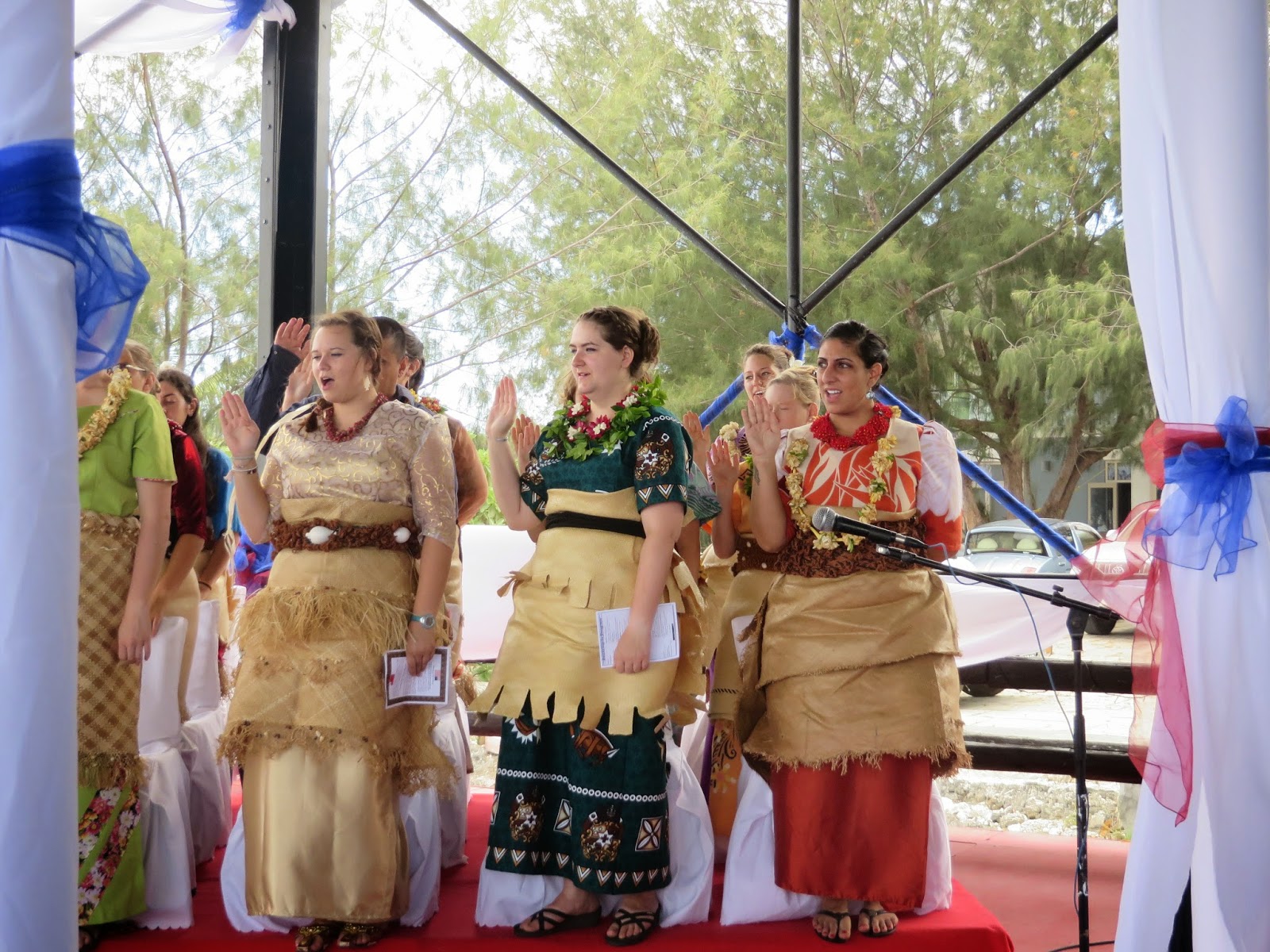
'Aho Faiva (Swearing-In Ceremony)

Promptly at 8 a.m. on Friday, Oct. 31, a horde of fearsome Tongan women armed with bobby pins, freshly ironed puletaha, flowered hair accents, and kahoa stormed into Sela’s Guest House. The mothers and several daughters from our host families got right to work preparing us for our Swearing-In ceremony, which was scheduled for 10 o’clock later that morning. 
Milise and I at Sela's Guest House before the Ceremony.
            “I don’t think so,” Milise said, taking one look at my hair. She abruptly grabbed another woman walking past, said a couple of quick sentences to her in Tongan—too fast for me to understand—and firmly pushed me into a nearby chair. The other woman returned after just a minute or so and, without a word, started undoing the braided bun at the back of my neck. Her deft fingers twisted and tucked thick strands of my hair into an up-do, all while Milise looked on with a fiercely critical eye. 
            When the other woman finished, Milise appraised her work, then beamed her big, gold-toothed smile, her eyes crinkling into slits. She laid the final touches: a white flower for my hair, and a pearl necklace draped over my collarbones. 
A view of my up-do from the back, in the van on our way to Swearing-In.
            The fifteen PCTs of Group 79 all piled into vans to head to Ita’s Guest House, where the ceremony was held. Our host families waved as we drove away, and then climbed into their own vehicles to follow closely behind.
            Ita’s had been transformed since the rehearsal on the day before. Bolts of red and blue cloth covered the ground of the open-air pavilion that looked out onto the shining water of the inlet. White drapes were fastened to the poles with blue and red ribbon, and a Peace Corps banner hung in the center of the display, above a podium draped in white cloth and a decorative mat woven of pandanus leaves. To the right of the podium, the Tongan flag waved proudly in a cool Tongan breeze. 
The decorated pavilion for the ceremony at Ita's Guest House.
            The Swearing-In ceremony featured several speeches from our Country Director, Eddie Stice, Tonga Ministry of education and Training (MET)’s Director of Education, ‘Emeli Pouvalu, our Director of Programming and Training, Paul Jurmo, and our Program Manager and Training Manager, Lavinia Palei and Elenoa Kauvaka. We swore an oath of loyalty to the United States Government, followed by a brief introduction of each PCT, stating our individual locations of service, followed by the presentation of laminated certificates officially recognizing us as Peace Corps Volunteers (PCVs). 
Me receiving my certificate from DPT Paul Jurmo, as an official PCV.

After we received our certificates, Bailey and Kelsey stood up to read a letter written to our host families in both English and Tongan, thanking them—on all of our behalf—for all that they had done to house us, feed us and love us over the past two months.
            Our cultural performances were up next. We had all spent several hours a night, several nights a week over the past month learning each of the dances and songs that we performed. By Tongan standards, they were probably all mediocre at best, but that didn’t stop us from performing them, or the audience from enjoying them, with reckless abandon.
           
PCVs Bailey Bollinger and Kelsey Smith reading the thank you letter.
While Kevin and Abrham performed their kailao (traditionally male dance done with spears), Liz, Kelsey, Alex and I were whisked outside to get ready for our hula. After the hula came a Tongan song, sung by Carrie Lee and Sammy, accompanied by Harry and Renee on guitar and ukulele.
The tau’olunga was the grand finale.  
            Under the pavilion, music played during a five-minute intermission to give us time to change into our faiva (show) outfits. Our host monsters dragged us out into the parking lot, stripped us down, and wrapped us in painted tapa cloth. Each design and outfit was different. Some had feathered hairpieces reaching more than a foot into the air; some had kafa ropes with shells intricately braided into them; some had flowered kahoa tied around their necks while others wore thin black chokers adorned with a single bleached shell. 
PCV Chiara Razzino's hairpiece for the faiva.
            Our host moms were a terrifying force to reckon with as they dressed us, yanking us here and there as they tugged and folded the cloth around us, and forced the hairpieces, wristlets and anklets into place.
They showed none of that shame or modesty we were told so adamantly that Tongans have. I still don’t know who did it, but one woman gave me a sharp little spank on my half-naked booty while Milise wrapped a tapa skirt around my hips; another woman reached her hands all the way up that same skirt as she lathered my legs in oil, then quickly moved on without missing a beat to my bare chest, shoulders and arms.
            When we were finally ready, we all filed into our positions on the stage. As soon as the music started, the chaos began. Tongans and palangis alike cheered, whooped, clapped and danced their way up to the stage to shove one-, two- and five-dollar bills down the front of our outfits and slap them onto our sticky, oiled limbs. 

            They danced beside and behind us to show their support for us as we officially began our two-year service as PCVs in the South Pacific Island Kingdom of Tonga.

Me and my LCF, Taua Tonga, at the Swearing-In ceremony.
Sammy, Bailey, Kayla and I before being sworn-in.
Group 79 PCVs swearing an oath of loyalty and service to the U.S. Government.
Kevin getting ready to do the kailao.
Abrham and Kevin dancing the kailao.
Harry, Sammy, Carrie Lee, and Renee performing a Tongan song on guitar and ukulele.
Harry, Liz, Alex, Kelsey, Kevin, Abrham and I performing the hula.
Dancing the tau'olunga.
Me with my certificate authorizing the completion of PST, and initiation as a PCV. Wahoo!

And here's the video of us doing the tau'olunga!
https://www.youtube.com/watch?v=Ob-rcKF12fo&feature=youtu.be